


Written and medically reviewed by W. van Donselaar, doctor, BIG 79020681301, on 16 June 2026.
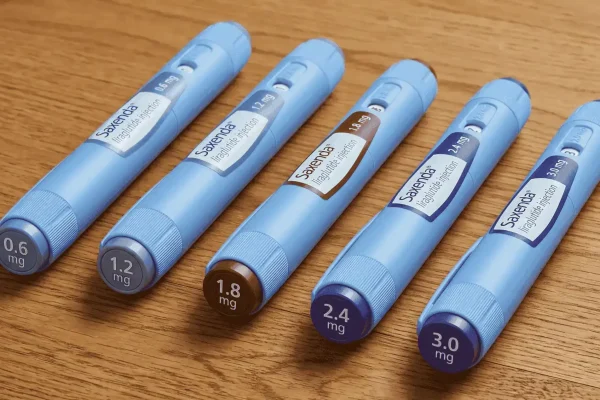
Saxenda contains liraglutide and is administered as a daily subcutaneous injection. You do not start on the full dose straight away. The titration takes place in five weekly steps, from 0.6 mg on day one to 3.0 mg after about a month. This schedule is so strictly defined because your gastrointestinal system needs time to adjust. Below you can read the full schedule, why the steps are structured this way, and what to do if you find a particular step difficult.
The complete structure diagram
The standard regimen is taken from the summary of product characteristics (SmPC) and is based on the SCALE trials of liraglutide. Each step lasts at least one week.
| Week | Daily dose | What’s happening? |
|---|---|---|
| Week 1 | 0.6 mg | The body gets used to liraglutide; mild nausea is common |
| Week 2 | 1.2 mg | First real step; symptoms may return briefly |
| Week 3 | 1.8 mg | A noticeable reduction in appetite among many users |
| Week 4 | 2.4 mg | Penultimate step; the effect builds up |
| From week 5 | 3.0 mg | Maintenance dose; you’ll stay on this for as long as the treatment lasts |
You should inject at roughly the same time every day. It doesn’t matter what time it is, as long as you do it consistently.
Why such a relaxed schedule?
Liraglutide slows down gastric emptying. Your food stays in your stomach for longer. This helps you feel full more quickly, but may also cause nausea and stomach ache at first. By increasing the dose by just one step each week, you give your digestive system time to adjust.
Increasing the dose too quickly does not improve the effect, but does increase the risk of discontinuation. In clinical trials, around four in ten users experienced nausea during the titration phase. For most, this subsided within a week once a stable dose was reached. Anyone who speeds up the schedule disrupts this stabilisation process and is more likely to experience severe side effects.
In the SCALE trials, the maintenance dose of 3.0 mg was found to result in the greatest weight loss. Lower maintenance doses are less effective.
What do you do if you’re intolerant whilst out on the town?
Not everyone can tolerate every step straight away. If you experience persistent nausea, vomiting or abdominal pain that does not subside within a week, do not move up to the next step. Stay on your current dose for an extra week and discuss this with your doctor or the team supporting your treatment programme. Only when the symptoms have subsided should you take the next step.
A slower build-up does not result in significantly less weight loss during this phase. The most important thing is that you reach the maintenance dose without any symptoms forcing you to stop. A few extra weeks is therefore much better than having to stop prematurely.
If you experience severe side effects or if you’re unsure, do not halve the dose yourself. Call your doctor. Any dose adjustment or interim step (for example, staying on the same mg dose for a few days) should be done in consultation with your doctor, not on your own initiative.
Are you unsure whether you can stick with the programme, given the side effects? In a supported programme, someone will be there to guide you every step of the way. Take our health check and find out if you’re eligible.
How long will you stay on 3.0 mg?
The maintenance dose is 3.0 mg per day for as long as you are on the Saxenda treatment programme. Saxenda is intended for long-term use in weight management, often for one to two years or longer. When treatment is stopped, many people gradually regain the weight they have lost, as the effect on appetite and satiety wears off once liraglutide has cleared from your system.
If you are unable to take 3.0 mg due to persistent side effects, your doctor may, in consultation with you, try a lower maintenance dose, for example 2.4 mg. This will have less of an effect on your weight, but if you tolerate it well, it is sometimes better than stopping the treatment altogether. You make this decision together with your doctor, not on your own.
Do the check if you’d like to find out whether a Saxenda support programme is right for you and how we’ll monitor your progress together.
What are the most common mistakes?
Three patterns we regularly come across in counselling:
- Increasing the dose too quickly in order to see results sooner: This increases the risk of severe nausea and failure. On balance, building up gradually is often more effective than pushing yourself too hard.
- If you miss a daily dose, take two doses at once: Never do that. With Saxenda: skip one day and simply take your usual dose the next day.
- Adjust the dose yourself if you experience mild nausea: As a result, you may end up staying on a sub-effective dose for too long. Discuss this with your doctor before adjusting your treatment plan.
For product information such as composition, contraindications and storage see the Saxenda page in our medication guide. For a guided route with Saxenda injections You can plan an initial consultation with check-ins at each dose increase. You can read more about what side effects to expect in What are the side effects of Saxenda?.
Key points blog
Why do I need to increase my Saxenda dose every week?
Why do I need to increase my Saxenda dose every week?
Liraglutide slows down gastric emptying. A weekly dose of 0.6 mg gives your gastrointestinal system time to adjust, keeping nausea and abdominal pain under control. For most users, these symptoms subside within that week.
What if I can’t cope with a particular step?
What if I can’t cope with a particular step?
You should then continue on your current dose for an extra week, in consultation with your doctor. Only increase the dose once your symptoms have subsided. A slower increase does not significantly reduce the effect on weight loss at this stage.
What is my maintenance dose after the build-up phase?
What is my maintenance dose after the build-up phase?
The recommended maintenance dose is 3.0 mg per day. If this is not possible due to side effects, a lower maintenance dose (2.4 mg) may be an option, in consultation with your doctor, although this may result in less weight loss.