


Medically reviewed by W. van Donselaar, doctor, BIG 79020681301, on 13 August 2026.
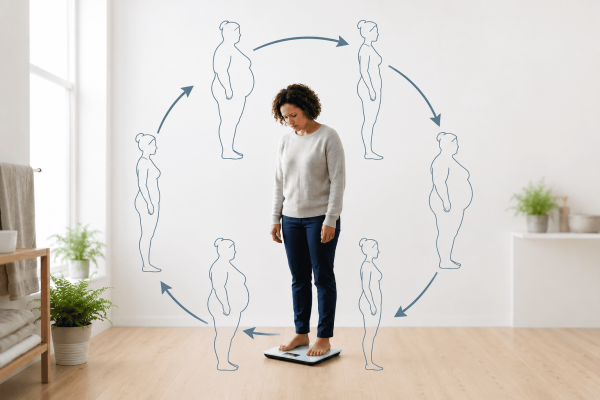
You’re so close. After weeks on a strict diet, you’re finally seeing results on the scales. And then, a few months later, you’re back where you started — or even heavier than before. If this sounds familiar, you’re not alone. The yo-yo effect is one of the most common experiences among people trying to lose weight on their own, and it has little to do with willpower.
In this blog, we explain what happens in your body during and after a diet, the role hunger hormones play in weight gain, and how you can break the yo-yo cycle for good. No quick fixes, just explanations to help you understand why previous attempts didn’t work in the long term — and what actually can help.
The short answer
You put on weight after a diet because your body actively reacts to weight loss. During and after a strict diet, your metabolism slows down, hunger hormones such as ghrelin increase, and the satiety hormone leptin decreases. As a result, you feel hungrier, burn less energy at rest, and your body actively works to return to its original weight. This mechanism is called metabolic adaptation. The yo-yo effect is therefore a biological reaction, not a sign of a lack of discipline. Breaking this cycle permanently requires an approach that takes these bodily processes into account, rather than working against them.
Are you considering medical weight loss? Take our health check. Do you know if you’re eligible? If so, fill in the simple questionnaire straight away to get started.
What happens to your body when you stop dieting
When you eat significantly less than your body is used to for a period of time, your body reacts as if there is a shortage of food. This is not an imagined reaction — it is a survival mechanism that has been part of our system for thousands of years. Your body cannot distinguish between “deliberately eating fewer calories to lose weight” and “insufficient food being available”. In both cases, it switches to a more energy-efficient mode.
Your metabolism slows down
One of the most important processes is metabolic adaptation: your resting metabolic rate – that is, the amount of energy your body uses at rest – drops more sharply than your weight loss alone would explain. Research into participants in weight-loss programmes shows that this slowed metabolism can persist for months or even years, even after weight has stabilised. This means that, after a diet, you often need fewer calories than before to maintain the same weight — whilst your appetite actually increases.
Muscle loss intensifies the effect
On a strict diet, you don’t just lose fat mass, but often muscle mass as well. As muscle tissue burns more energy than fat tissue, this further accelerates the decline in your metabolic rate. Without paying specific attention to protein intake and exercise whilst losing weight, this effect is difficult to prevent.
Your body “remembers” your highest weight
There is a theory in science that explains this as a ‘defended weight range’: your body seems to use a sort of reference point, which it adjusts upwards more often than downwards. After weight loss, your body sets in motion all sorts of hormonal and metabolic processes to restore that previous, often higher, weight. This explains why losing weight is often successful, but maintaining that weight is much more difficult.
The role of hunger hormones in weight gain
As well as metabolism, hormones play a direct role in why you end up eating more than you intended after a diet. This isn’t because you’re “weak”, but because the signals your brain sends out literally change.
Ghrelin: the hunger hormone
Ghrelin is produced in your stomach and sends a hunger signal to your brain. Following weight loss, ghrelin levels rise, often permanently. You then feel consistently hungrier than before the diet, even once your weight has stabilised. This makes it considerably more difficult to maintain a lower energy intake in the long term.
Leptin: the satiety hormone
Leptin is produced by adipose tissue and signals to your brain that there are sufficient energy reserves. When you lose weight, leptin levels fall, causing the feeling of fullness to diminish. Your brain, as it were, receives the message that there are insufficient reserves, even though this is no longer actually the case.
Other hormonal signals
Hormones such as peptide YY, GLP-1 (the body’s own hormone, not to be confused with medication that acts on this hormone) and insulin also change following weight loss. Together, these changes cause your brain to become more focused on food, with greater attention to food, a stronger urge to eat larger portions and a reduced sense of fullness.
Immediate reply: Hunger hormones such as ghrelin rise and satiety hormones such as leptin fall following a diet. This leads to persistent increased hunger and reduced feelings of fullness, even after weight has stabilised — a major cause of the yo-yo effect.
Why this isn’t down to a lack of willpower
These hormonal changes can last for months or even years. This means that people who put the weight back on after a diet often do so despite their best intentions and discipline. For many people, the biological urge to eat more and burn fewer calories is simply too strong to resist on a long-term basis without support.

How can you break the yo-yo cycle for good?
As the yo-yo effect is driven by physiological processes, the solution is rarely “going on yet another diet”. A structural approach focuses on the underlying mechanisms rather than just the short-term outcome.
1. Opt for a more gradual approach
Rapid and significant weight loss intensifies metabolic adaptation and the hormonal response described above. A more gradual approach, with sufficient energy intake and attention to nutritional value, gives your body a better chance of adapting without triggering a strong “starvation mode”.
2. Maintain muscle mass
Adequate protein intake and regular exercise, particularly strength training, help to maintain muscle mass during weight loss. This limits the decline in your resting metabolic rate and makes long-term weight maintenance more achievable.
3. Focus on the phase following weight loss
Many attempts to lose weight stop as soon as the target weight is reached, whereas it is actually the period that follows which is crucial. A good approach pays systematic attention to the stabilisation phase: how to adjust your eating habits, how to deal with hunger cues, and how to recognise a relapse at an early stage.
4. Consider seeking medical advice if previous attempts have not produced lasting results
If you have lost and regained weight several times, this may indicate that hormonal and metabolic processes play a greater role in your case than is average. In that case, a medical treatment programme may offer a solution. A doctor will first assess your individual situation — including your health, eating habits and previous attempts — before determining which approach is most suitable. Not everyone is eligible for the same treatment, and at WeightConsult, medication is never the starting point, but at most one component of a broader, personalised support programme.
Immediate reply: You can break the yo-yo cycle in the long term by losing weight more gradually, maintaining muscle mass, focusing specifically on the stabilisation phase after weight loss, and, where necessary, seeking medical advice that takes your individual hormonal and metabolic situation into account.
Practical tips
- Avoid very strict low-calorie diets; opt for a gradual approach that you can stick to for longer.
- Make sure you get enough protein and exercise regularly to maintain muscle mass.
- Once you’ve reached your goal, make a conscious effort to spend time in the stabilisation phase, rather than immediately reverting to your old eating habits.
- Seek medical advice if you find that feelings of hunger and weight gain keep recurring despite your efforts.
Key insights
- The yo-yo effect is caused by biological processes such as metabolic adaptation, not for lack of willpower.
- Following weight loss, your resting metabolic rate often drops more sharply than weight loss alone would explain.
- The hunger hormone ghrelin rises and the satiety hormone leptin falls following a diet, causing hunger to increase and feelings of fullness to decrease.
- Gradual weight loss and the preservation of muscle mass minimise the metabolic and hormonal effects of weight loss.
- In the event of repeated relapses, medical support help to tackle the underlying causes of the yo-yo effect in a targeted manner.
Conclusion
Putting the weight back on time and again after a diet is not a personal failure, but the result of how your body reacts to weight loss. A slowed metabolism, changing hunger hormones and your body’s tendency to return to its previous weight make the yo-yo effect almost inevitable for many people without a targeted approach. Anyone wishing to break this pattern in the long term will benefit from a gradual approach, focusing on the post-weight-loss phase and, where necessary, professional and medical support tailored to their individual situation.
Do you recognise this pattern and would you like to know whether a medical treatment programme is suitable for your situation? Start your BMI check and find out whether personalised support could be the solution for you.
Key points blog
Why do I keep putting on weight again after going on a diet?
Why do I keep putting on weight again after going on a diet?
Because after weight loss, your body actively responds by slowing down your metabolism and altering your hunger hormones, making you feel hungrier and burn less energy — the yo-yo effect is therefore a biological process, not a lack of discipline.
Which hormones play a role in the yo-yo effect?
Which hormones play a role in the yo-yo effect?
Ghrelin (the hunger hormone, which increases) and leptin (the satiety hormone, which decreases) in particular play a role, along with other signals such as insulin and peptide YY.
How can I stop myself from putting the weight back on after losing it?
How can I stop myself from putting the weight back on after losing it?
By losing weight more gradually, maintaining muscle mass through diet and exercise, paying close attention to the period following weight loss, and considering medical support in the event of repeated relapses.