


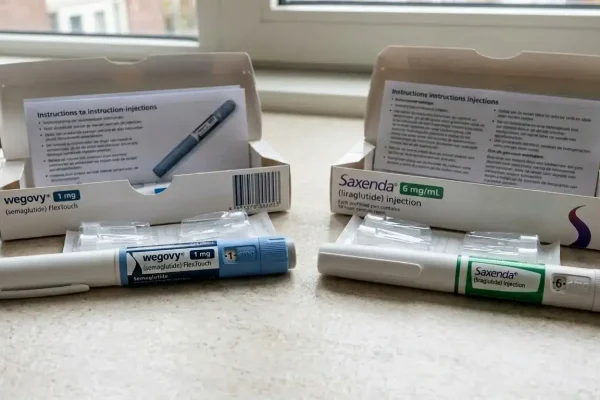
Wegovy and Saxenda often pop up first when medication is considered for overweight or obesity. Online, the conversation then quickly turns to “which drug gives the most weight loss”. In practice, a responsible choice usually revolves around something else: what is medically appropriate, what is maintainable in daily life and what is safe.
Wegovy and Saxenda: what they are and the main differences
Wegovy and Saxenda are both GLP-1 receptor agonists. These drugs mimic the GLP-1 hormone. This is a body's own signal that affects satiety, appetite and gastric emptying, among other things. As a result, many people notice fewer cravings and an earlier feeling of fullness.
They remain prescription drugs that fit within long-term weight management.
The core differences are in the active ingredient and practical implementation. Wegovy contains semaglutide and is usually injected once a week. Saxenda contains liraglutide and is injected daily. Semaglutide works longer than liraglutide. This also explains the difference in injection rhythm. Both drugs have a build-up phase to limit side effects, and starting them should be done under medical supervision.
| Criterion | Wegovy | Saxenda |
|---|---|---|
| Active substance | Semaglutide | Liraglutide |
| Injection | Weekly | Daily |
| Construction | Step by step | Step by step |
| Weight loss on average | 12-15% | 10-15% |
Choosing based on suitability and safety
The choice between Wegovy and Saxenda is usually not a ranking based on the highest average weight loss. Medication is usually considered in adults in the Netherlands. BMI and medical context together then determine whether starting makes sense. In many care pathways, a BMI above 27 is the starting point for assessment, with an emphatic note that a doctor always weighs whether the benefits outweigh the risks.
A compact safety assessment starts with situations where extra caution is appropriate, or where additional information is needed first. Pregnancy, breastfeeding or an active desire to have children, for example, require extra care. A history with pancreatitis or relevant gallbladder complaints also comes into play. In addition, conditions in which dehydration or renal load may occur more quickly are considered, especially when gastrointestinal symptoms are in the foreground. In some situations, a specific oncological or thyroid history may also be part of the consideration. This is discussed in understandable language during the intake.
At an intake, therefore, not only height and weight are asked, but also weight history and previous attempts. Often comorbidities such as type 2 diabetes or cardiovascular risk factors are also discussed, as is current medication use. Gastrointestinal complaints, allergies and lifestyle patterns are included as they influence side effects, accrual rate and monitoring. If necessary, additional medical information is requested, for instance through the GP, so that the starting decision is carefully substantiated.
Considering the medical way to lose weight? Schedule a no-obligation consultation at WeightConsult. Do our own health check and contact us easily online
Choosing based on suitability and safety
The choice between Wegovy and Saxenda is usually not a ranking based on the highest average weight loss. Medication is usually considered in adults in the Netherlands. BMI and medical context together then determine whether starting makes sense. In many care pathways, a BMI above 27 is the starting point for assessment, with an emphatic note that a doctor always weighs whether the benefits outweigh the risks.
A compact safety assessment starts with situations where extra caution is appropriate, or where additional information is needed first. Pregnancy, breastfeeding or an active desire to have children, for example, require extra care. A history with pancreatitis or relevant gallbladder complaints also comes into play. In addition, conditions in which dehydration or renal load may occur more quickly are considered, especially when gastrointestinal symptoms are in the foreground. In some situations, a specific oncological or thyroid history may also be part of the consideration. This is discussed in understandable language during the intake.
At an intake, therefore, not only height and weight are asked, but also weight history and previous attempts. Often comorbidities such as type 2 diabetes or cardiovascular risk factors are also discussed, as is current medication use. Gastrointestinal complaints, allergies and lifestyle patterns are included as they influence side effects, accrual rate and monitoring. If necessary, additional medical information is requested, for instance through the GP, so that the starting decision is carefully substantiated.
From comparison to responsible choice
A responsible choice between Wegovy and Saxenda arises when suitability and safety are leading, and practical feasibility, side effects, realistic expectations and costs follow logically from these. When those points are clear, an individual assessment can determine which drug and what build-up rate is appropriate, and whether starting at this time is wise. In that case, scheduling an intake is most obvious, so that options can be carefully discussed based on medical data and daily routine.