


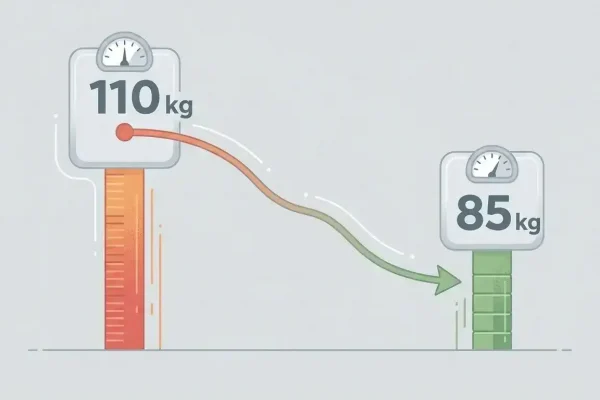
Hoping to notice results quickly is understandable, especially if previous attempts required a lot of effort and gave little guidance. At the same time, “it works” with Mounjaro means less appetite for some, while others notice that meals fall differently or that blood sugar problems calm down. Visible difference on the scales then often follows later.
Such variation is normal. The rate is determined by individual response, the safe dose structure and the basis provided by lifestyle. This becomes clearer once “effect” is first sharply defined.
What does ‘working’ at Mounjaro mean?
At the Mounjaro injection (tirzepatide) “effect” can take different forms. It may include being satiated earlier, less constant thoughts of eating, less snacking or a calmer eating rhythm. In people with dysregulated blood sugar, a more stable glucose profile may also become noticeable. Visible weight loss is also part of this, but often comes later and is usually gradual.
The fact that the response rate varies has several causes. Consider starting weight, eating pattern, sleep, stress, comorbidity and other medication. How well the body tolerates the drug during the build-up also plays a role. Comparing results one-to-one with others therefore quickly gives a distorted picture. Medical supervision helps to interpret signals properly, limit side effects and carefully decide on increasing or slowing down, with lifestyle as a fixed basis.
With this distinction, the timeline also becomes more realistic to place.
A realistic timeline: from first injection to the months following it
Mounjaro is usually administered 1× a week. The body can respond within hours, but what is noticeable varies from person to person. Some people experience less appetite or faster fullness within 1-2 days. Others notice more subtle changes, such as less need for large portions or less cravings between meals. Towards the end of the week, the effect may diminish somewhat in some people, which fits with weekly administration.
The first weeks often run along two tracks: getting used to and building up. The starting dose is meant to build up tolerance, not maximum pace. Increasing is done in steps, often at least 4 weeks per dose step and depending on effect and side effects, until an appropriate maintenance dose is reached. Visible change on the scales occurs more clearly in many people when the diet becomes more stable and the dose has sufficient effect, which usually takes weeks to months.
To track progress meaningfully, it helps to focus less on daily fluctuations and more on trends and carrying capacity. Then pay attention to the course of hunger and satiety, portion size, the number of eating occasions, any gastrointestinal complaints, energy levels and the development of weight and waist circumference over several weeks.
| Moment | Often noticeable | Weight (bandwidth) |
|---|---|---|
| Month 1 | Habituated, eating loop inhibition | 0-3% |
| Month 3 | More stable rhythm, more effect | 3-8% |
| Month 6 | Maintenance dose, consolidation | 5-12% |
Overall, we see an average possible weight loss of 15-22%. These ranges are not a promise. They get wider or narrower due to dosing rate, side effects, starting weight, lifestyle and medical factors such as diabetes or medication that affects weight, among others.
Especially in the starting phase, tolerance often sets the pace. Therefore, it pays to have side effects and adjustment moments clear from the start.
First weeks: side effects, what you can do yourself and when to contact
Side effects in the starting phase are relatively common and are usually in the gastrointestinal area, such as nausea, feeling full, belching, constipation or just diarrhoea. This fits with the way the drug affects satiety and can delay gastric emptying. Complaints are not automatically a sign that it is “working well”. Continuing without adjusting is therefore rarely wise.
Practically, what sounds simple often helps the most: smaller portions, eating slowly, stopping at the first satiety signal and temporarily limiting high-fat or highly spicy meals. For nausea, keeping meals simple and taking something small more often can help. For constipation, sufficient fluids, daily exercise and gradually building up fibre often work better than “extra much” fibre all at once. For diarrhoea, it helps to eat lightly digestible food temporarily and be alert to dehydration.
The difference between “annoying but expected” and “don't wait and see” is important here. Consult with a healthcare provider the same day for these signs:
- Persistent vomiting or inability to drink. This increases the risk of dehydration and dysregulation.
- Severe abdominal pain, especially with fever or radiation. This should be assessed.
- Signs of an allergic reaction. For example, swelling, tightness of the chest or hives.
- Pregnancy or childbearing. Safety and planning require medical coordination.
The tendency to quickly ramp up because “things are not going fast enough yet” also requires consultation. Building up too quickly increases the risk of side effects and dropouts, and does not automatically lead to better results.
Moreover, when symptoms and appetite shift, eating and drinking suddenly become part of adjusting. A few practical principles then provide guidance.
Considering the medical way to lose weight? Schedule a no-obligation consultation at WeightConsult. Do our own health check and contact us easily online
Foods and drinks that support the effect (and may reduce symptoms)
When appetite decreases, there is a risk of meals becoming too small or too irregular. Later in the day, this can actually cause cravings or energy dips. A workable framework is: regularity, protein as an anchor and fibre as support, with room to simplify temporarily in case of symptoms. Protein helps maintain muscle mass better during weight loss, while fibre contributes to satiety and bowel movements. For sensitive gastrointestinal complaints, it is often better to build up fibre slowly and choose mild sources.
The question of how much water is appropriate has no universal answer. A practical guideline is to drink enough daily to keep urine light in colour, with extra attention to fluids in cases of diarrhoea, vomiting, hot weather or increased exercise. Water is fine, and tea or broth can also help when nausea is in play. Alcohol and large, fatty meals are more likely to cause symptoms in the first weeks, especially around prick day and the day after.
A simple weekly structure can help support effect and tolerance together.
- Prick day: Plan easily digestible meals and eat slowly.
- Day 1-2 after: Choose smaller portions, with protein as a base.
- Rest of the week: Keep fixed meal times and add vegetables and fibre gradually.
- Exercise and sleep: A daily walk and a stable sleep rhythm help dampen hunger pangs.
As such, exercise and sleep are not “extras”. Sleep deprivation and little exercise make it harder to recognise satiety signals and stay consistent, especially when the dose is still being built up.
If those basics are in place and yet the impact lags, it makes sense to look at what exactly “low response” means at this stage.
If it doesn't work enough (yet): causes, reassessment and stopping safely
“Little effect” can mean that appetite and eating behaviour hardly change, that weight does not move after a few weeks, or that side effects make it impossible to achieve an effective dose. This often has explanations that can be influenced. For instance, a dose that is still mainly focused on habituation, a too fast or too slow build-up, or irregular meals because appetite is low. Factors such as stress, lack of sleep, alcohol or medication that can stimulate weight gain can also play a role.
In a supervised course, reassessment is usually not a snapshot, but a combination of measurement points: tolerance, lifestyle pattern and a weight and symptom progression over several weeks. Often an evaluation after several dosage steps is more meaningful than after a single injection. If, after appropriate build-up and sufficient time on an effective dose, there is still insufficient response, a reconsideration is part of the process. This may mean continuing to adjust, pausing, discussing an alternative or temporarily shifting the focus to lifestyle and other medical factors.
Quitting also requires a plan. Abruptly stopping can lead to rapid return of appetite and old patterns, putting pressure on the outcome achieved. In addition, it is unsafe to seek (imitation) drugs outside regular, prescription care channels. Medical triage, quality control and guidance on side effects are then lacking. When in doubt, the most logical route is therefore: first medically check what is going on, and only then decide on increasing, adjusting or stopping.
The next step: from timeline to safe treatment plan
Mounjaro can produce early effects on appetite and satiety, while visible weight change tends to be more gradual and related to dose accumulation, tolerance and lifestyle. Those who set the pace realistically and follow signals closely are more likely to recognise when adjustment is needed and when patience is just appropriate.
If a personal assessment of suitability, risks, goals and next steps is desired, a free consultation can help to go through this carefully within regular, prescription care, with attention to privacy and coordination with one's own GP and pharmacy.